What Makes a Weight Loss Supplement Legit vs Hype

Disclosure: This site may contain affiliate links. This content is for informational purposes only and does not constitute medical advice.
KEY TAKEAWAYS
- Legit supplements name their ingredients and doses; hype hides behind “proprietary blends.”
- Legit claims say “supports”; hype says “melts,” “flushes,” or “guaranteed.”
- Real products cite research on their actual ingredients; hype relies on testimonials and before/after photos.
- The single best filter: does the product’s promise match what the ingredient evidence actually shows?
The weight-loss supplement aisle is a minefield of bold promises, and telling the legitimate products from the hype can save you money, disappointment, and sometimes your health. The good news: the tells are consistent once you know what to look for. Here’s the honest filter.
Tell #1: Named Ingredients vs. “Proprietary Blends”
The first and clearest tell is transparency.
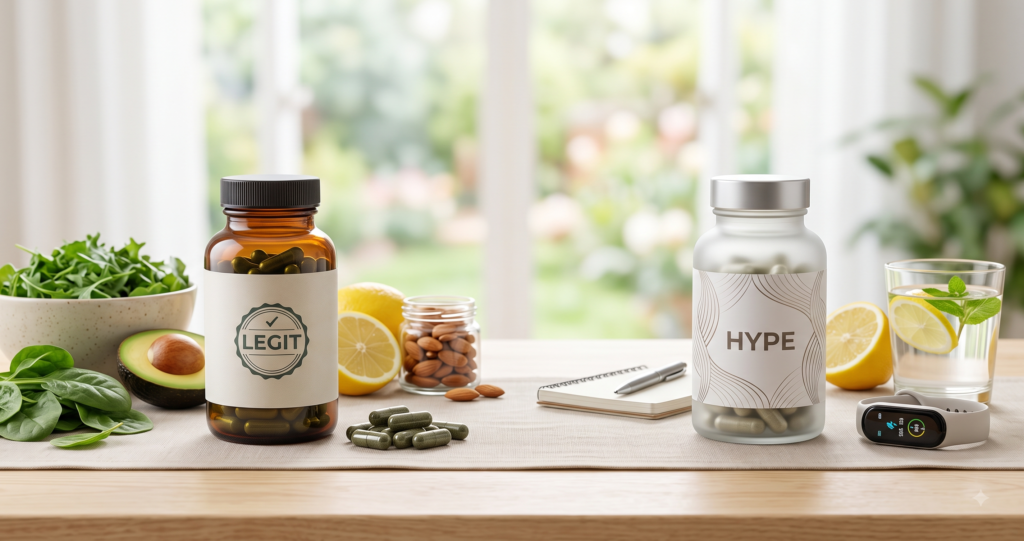
Legit: the label lists each ingredient and its dose. You can look up whether that ingredient has evidence and whether the dose matches what studies used.
Hype: the label hides behind a “proprietary blend” — a single combined number with no individual doses. This isn’t protecting a secret recipe; it’s preventing you from checking whether there’s a meaningful amount of anything active in there.
If you can’t see the doses, you can’t evaluate the product. A proprietary blend is a red flag, full stop.
Tell #2: “Supports” vs. “Melts, Flushes, Guaranteed”
The language a product uses tells you how honest it’s being.
Legit products use careful, accurate verbs: “supports metabolism,” “may help,” “supports liver function.” That’s not weak marketing — it’s honesty about what supplements actually do.
Hype reaches for dramatic, absolute language: “melts fat,” “flushes toxins,” “guaranteed results,” “cures.” These are exactly the claims the evidence never supports — no supplement melts fat or guarantees results, and “flushes toxins” misrepresents how the body works.
The rule: the bolder and more absolute the promise, the less likely it’s backed by science.
What a “Sluggish Liver” Really Means for Your Metabolism
Tell #3: Ingredient Research vs. Testimonials
Look at what a product uses as evidence.
Legit: it points to research on its actual ingredients — studies on silymarin, berberine, green tea, whatever it contains. You can verify those studies exist and say what’s claimed.
Hype: it leans on testimonials, dramatic before/after photos, and “as seen on TV” badges. Testimonials are unverifiable and selected; they tell you what one person claims, not what the product reliably does. Before/after photos are the weakest form of evidence there is.
A product confident in its ingredients cites the science. A product without science sells stories.
Tell #4: Realistic Timelines vs. Overnight Miracles
Legit products set honest expectations: gradual results over weeks or months, paired with diet and exercise. That matches how real ingredients work — the silymarin and berberine research runs 8–24 weeks.
Hype promises speed: “results in days,” “lose 20 lbs in 3 weeks.” That’s water weight at best, and a rebound at worst. No legitimate metabolic ingredient works that fast.
If the timeline sounds too good to be true, it is.
Tell #5: The Master Filter — Does the Promise Match the Evidence?
All the tells above collapse into one question: does the product’s promise match what its ingredients’ evidence actually shows?
- Silymarin has evidence for supporting liver function — so “supports liver health” is legit; “melts belly fat overnight” is hype.
- Berberine has evidence for liver fat and blood sugar, paired with lifestyle — so “supports metabolism alongside diet” is legit; “effortless fat loss” is hype.
When a product’s promise runs ahead of its ingredients’ evidence, that gap is the hype. A legit product’s claims stay inside what the science supports.
This is the filter worth applying to everything — including the products we review on this site. A formula like HepatoBurn, for instance, earns “legit” points for disclosing its ingredients and using evidence-backed actives like silymarin and berberine — while we’re equally clear that its benefits are gradual and lifestyle-dependent, not a guaranteed miracle.
–> See the latest HepatoBurn pricing and availability
Frequently Asked Questions
How can I tell if a weight loss supplement is legit?
Check five things: named ingredients with disclosed doses (not a “proprietary blend”), careful language (“supports” not “melts/guaranteed”), research on its actual ingredients (not just testimonials), realistic timelines (weeks/months, not days), and whether its promise matches the ingredient evidence.
Are “proprietary blends” a bad sign?
Generally, yes. A proprietary blend hides individual ingredient doses, which prevents you from checking whether there’s a meaningful amount of anything active. Transparency — named ingredients with disclosed doses — is a hallmark of legitimate products.
Why shouldn’t I trust before/after photos and testimonials?
They’re unverifiable and selected — you see the curated best cases, not representative results, and there’s no way to confirm them or separate the product from diet, exercise, or other factors. Legitimate products cite ingredient research instead.
What’s the single best way to spot hype?
Ask whether the product’s promise matches what its ingredients’ evidence actually shows. When the claim (“melts fat,” “guaranteed”) runs far ahead of the science (“supports metabolism, gradually, with diet”), that gap is the hype.
Conclusion
Telling a legit weight-loss supplement from hype comes down to consistent tells: named ingredients with disclosed doses, honest “supports” language, real ingredient research over testimonials, realistic timelines, and — the master filter — a promise that matches the evidence. Hype hides doses, makes absolute claims, sells stories, and promises miracles.
Apply this filter and most of the aisle falls away, leaving the few products honest enough to say what supplements actually do: support a healthy routine, gradually, alongside diet and exercise. That’s not the exciting answer — it’s the true one.
Part of evaluating any supplement honestly is knowing its potential downsides. So before starting one, here’s a frank look at side effects and who should be cautious.
References
- Remedy’s Nutrition / 2024 systematic review — Silymarin evidence and realistic claims. https://remedysnutrition.com/blogs/letter-vitamins/milk-thistle-for-fatty-liver-and-nafld-evidence
- PLOS One — Berberine and NAFLD: evidence with lifestyle. https://journals.plos.org/plosone/article?id=10.1371/journal.pone.0134172
- PMC — Berberine and silymarin: mechanisms and evidence quality. https://www.ncbi.nlm.nih.gov/pmc/articles/PMC11478310/
About the author: Diana Woods researches and writes evidence-based content on weight management and metabolic health for WeightLossReviewPro. Her articles are grounded in current published research and cite primary medical sources. Diana is a content researcher and writer, not a medical professional — her work is informational and is not a substitute for advice from your own doctor.