Weeknight Dinner Routine: Why It Falls Apart at 6 P.M., and Why It Isn’t Willpower

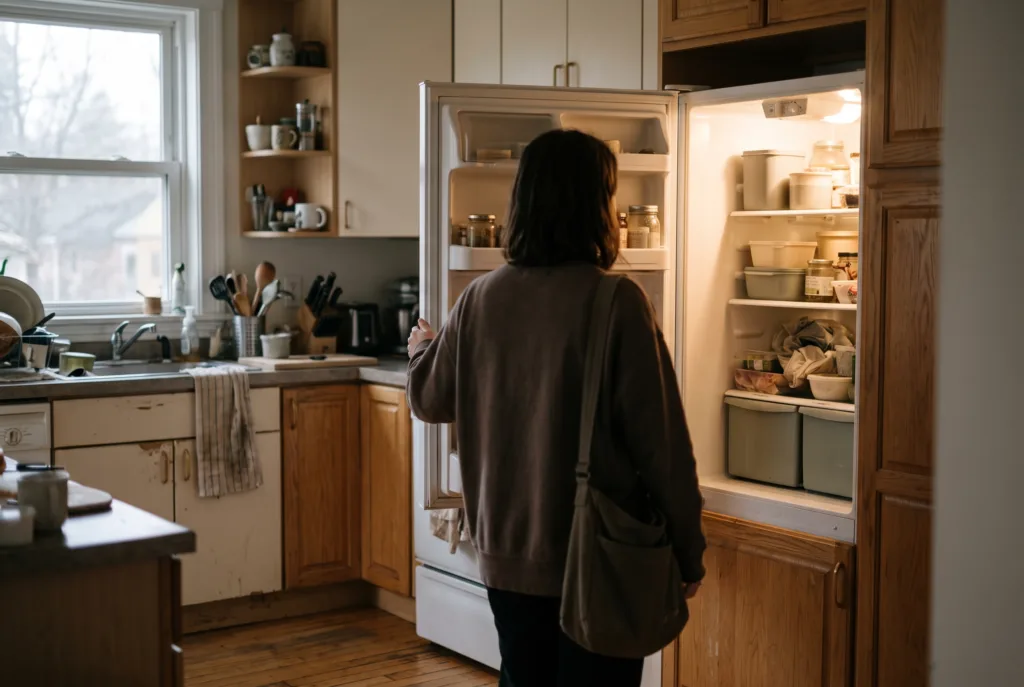
It’s 5:52 on a Tuesday. Keys in the bowl, bag on the nearest chair, refrigerator door open, its light on your face. Someone has turned up in the doorway to ask what’s for dinner, in the voice of a person who assumes the answer is stored somewhere. It isn’t. You study the shelves like a map of a city you’ve never visited.
The standard explanation for what happens next is that your willpower ran out. The day took it all and left the evening with scraps. It’s a neat story, and it lets everyone off the hook, including whoever hasn’t thought about dinner since breakfast.
I’d like to offer a duller one. The evidence leans toward logistics, not stamina. The hour is hard because the decision arrives last and unprepared, with an audience, and because somebody is usually carrying part of it without anyone noticing. Here’s what research says about each piece, and where it stops.
“Willpower runs out by evening” has a weaker record than you’d think
The idea behind the neat story is called ego depletion: self-control is a tank, and every effortful task drains a little. For years it was repeated everywhere, in textbooks and self-help alike.
Then a big group of labs tried to repeat it with the same protocol. Martin Hagger and colleagues ran a preregistered replication across 23 laboratories with 2,141 participants and found a pooled effect of 0.04, with a range from slightly negative to 0.15, so zero is inside it [1]. Put plainly, the replication didn’t find reliable evidence that the tank works the way it was described.
Two caveats. This tested a particular laboratory task, not a kitchen at 6 p.m., so it doesn’t prove evenings are easy; people really can be tired, hungry and distracted. And I’ve only read the abstract, and researchers are still arguing about what a null result like this means for the wider field.



What I take from it is small. The feeling at 6 p.m. is real: you can be worn out without having run out of anything in particular. But the explanation matters, because it decides what you try next. “I’m out of willpower” is weaker than it feels, and weak explanations tend to produce weak fixes. If the problem is a drained tank, the fix is to get better at being drained. If it’s something else, there’s something to change.
What a camera sees at dinner
The best look at what actually happens in that hour comes from somewhere unexpected: a video study. Researchers at UCLA’s Center on Everyday Lives of Families filmed two weeknight dinners in each of 32 Los Angeles families where both parents worked, 64 dinners in all, 45 of them cooked at home. Margaret Beck summarized the findings in Food Technology magazine [2].
The numbers are tamer than the folklore, which has cooking as a heroic, hours-long ordeal. Hands-on cooking took 34 minutes on average, and total preparation about 52. Meals built mostly from convenience foods took 26 hands-on minutes against 38 for meals from scratch, and only that hands-on gap was statistically meaningful. Mothers took part in 91 percent of the dinners, fathers in 33.
What I’d underline is what happened before. Families shopped several times a week, often without a list or in an emergency. And the author’s own suggestion is that planning and shopping may be a bigger barrier to cooking at home than the cooking itself.
The fine print: this was 2002 to 2004, in one city, among middle-class two-income families with children. It’s observational, so it tells you what happened, not why, and I’m reading a trade magazine’s write-up, not the original papers. But it fits a picture where the cooking is about half an hour of a long evening, and the part that goes wrong happens before anyone lights the stove.
Weeknight dinner routine: the decision gets made last, by whoever noticed first
A different kind of study helps here. Allison Daminger interviewed both members of 35 couples, 70 interviews in all, about what she calls the cognitive dimension of household labor [3]. Her argument is that running a home includes a kind of work separate from the physical chores, and that it comes in four stages: anticipating a need, identifying options for meeting it, deciding, and monitoring how it went.
What she found: women did more of the cognitive labor overall, and especially more of the anticipating and monitoring. The deciding was shared about equally, which she ties to power and influence in the household.
Lay that over the kitchen at 5:52. Anticipating is knowing on Monday that Thursday is the night with the late meeting. Identifying options is having some idea what could be made with what’s in the house. By the time anyone is standing in front of the refrigerator, only the third stage is left, and the first two were either done invisibly by one person or not done at all. If nobody anticipated Tuesday, Tuesday gets decided at the open door, under pressure, with an audience.
And if you live alone, the four stages are still there. You’re just all four people, and none of them has spoken to the others since morning.
That reading is mine, not hers. Her study wasn’t about dinner, it’s a small interview sample, and the abstract doesn’t say how the couples were recruited. But it gives the problem a shape: the hard hour may be the visible end of work that did, or didn’t, happen earlier.
Move the decision, not the cook
None of this has been tested. It’s what the studies above suggest if you take the logistics seriously, roughly from least effort to most.
Make the decision when you aren’t hungry. Not a week of dinners, just one: sometime before you leave work or the house, ask what tonight is, and answer it. Two minutes, once a day. It moves the deciding to a time when nobody’s standing in a doorway waiting.
Keep a standing fallback: one dinner everybody in the house agrees counts as dinner, that can be made from what’s usually around, and that got chosen in daylight. It’s not a failure and it’s not a moral category, and it’s not the standard you’re held to. It’s what happens on the Tuesday when nothing else did.
Say out loud who’s anticipating. If one person is the one who knows Thursday is complicated, that’s work, and it deserves a name. Splitting it can be as small as one person owning Monday’s check and another owning Wednesday’s.
And check that the shopping can carry the week. The filmed families shopped often and without lists. A trip that leaves the kitchen empty for Thursday has already decided Thursday.
Try one for two weeks, not all four at once. If you change everything, you’ll never know which part did the work, and you’ll quietly abandon the whole thing by the second Thursday. If 6 p.m. doesn’t feel any different after a fair try, you’ve ruled something out, which counts as a result.
What the refrigerator light is lit for
That light in the open refrigerator works like a spotlight. It makes the kitchen look like where the problem lives. But a lot of what’s in that hour got decided earlier, or never got decided at all. If you could move one thing from 5:52 to some calmer moment, which would it be?

Diana Woods researches and writes about sleep, environment and everyday habit. She has no clinical training, and that shapes what this site does: instead of explaining what might be wrong with you, she reads the behavioural and environmental research and writes about the parts you can act on — the light in the hallway, the fifteen feet to the bathroom, what the morning does to the night that follows.
Every article here cites its sources, and she tries to include the parts researchers themselves flag as uncertain. Studies disagree, sample sizes are small, and correlation gets reported as cause more often than it should. Saying so is part of the job.