Cooking for a Family With Different Eating Habits: When You’re the Only One Changing Things

Key Takeaways
- The friction in a household where one person is changing how they eat is mostly logistical. In one study, two of the four ways partners got in the way were not being able to plan meals and not being able to control the food environment of the home.
- Three kitchen setups come up again and again: one meal adjusted at the table, a shared base with separate finishes, and separate dishes. I could not find a study that compares them. In the one that comes closest, people who cooked or ate separately to keep the peace sometimes felt isolated.
- The person changing how they eat is often not the person who cooks. A small study found food provision was often framed as women’s work, and partners sometimes felt they had to justify doing less.
- Settle the work, not the argument. Talk about who cooks, on how many nights and who carries the second pan, away from the stove and before anyone is hungry, then try one setup for two weeks.
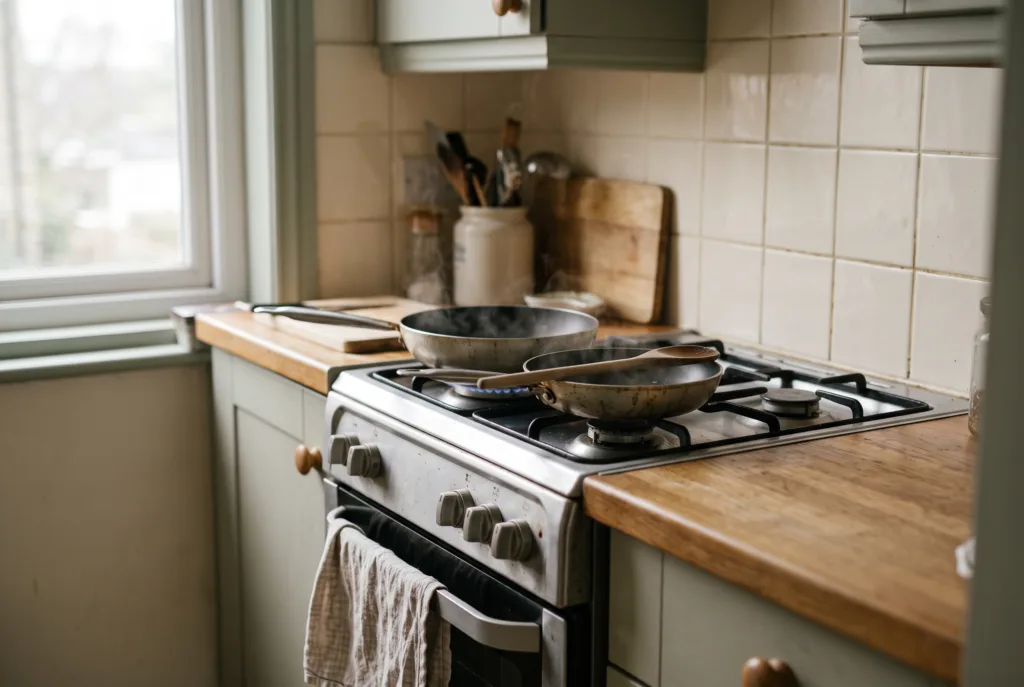
It’s 6:10 on a Thursday, and there are two pans on the stove. One is yours. Nobody asked for the second pan, and nobody offered to wash it either, and somewhere around the time the first one starts to smell like dinner, you notice that you’ve become a short-order cook in your own kitchen.
Nobody warns you about this part. The advice is all about what to eat, and the part that actually eats your evenings is the arithmetic of two meals, one stove and a household that did not sign up for your change. That arithmetic is a logistics problem, and it is usually treated as a willpower problem.
So this is about the pans. It looks at what research says about how households respond when one person changes how they eat, why the cooking so often lands on whoever is already tired, and three ways to set up the kitchen that people seem to land on. It says nothing about what belongs in any of them, because that’s not what this site does.
The trouble is rarely the food
Start with the people who study this from the inside. Rydén and Sydner interviewed 14 people who had taken part in a three-month eating-change programme and then tried to keep up the change at home [1]. The finding that stands out is that relationships were the biggest barrier to sticking with it, and especially the ones inside the household. The people they interviewed needed what the authors call coping strategies, every day.
It’s a small group, all from one programme, and it’s an abstract I’m working from, so I can’t tell you what those strategies were. But the direction fits a second study. Jennifer Theiss and colleagues asked 122 people to describe, four times over two months, how their romantic partner had recently affected their weight loss efforts [2]. The themes in the “hindering” column weren’t about opinions at all. Two of the four were an inability to plan meals and an inability to control the food environment of the home.



Read that again, because it matters. Those are scheduling and territory problems. They aren’t disagreements about whether the change is a good idea. They’re what happens when two people share one fridge, one grocery budget and one 6 p.m.
The limits are worth stating. Everything comes from the person making the change, in their own words, and the partners weren’t asked. Content analysis is also interpretive, so the themes are the researchers’ reading. But it’s a useful reframing: if the friction is mostly logistical, a logistical fix is at least on the table.
Cooking for a family with different eating habits: three setups, and what’s actually known
When people describe how they handle it, three arrangements come up again and again. I’m describing them from common sense, not from a study that compared them, because I couldn’t find one.
One meal, adjusted at the table. The household eats the same dinner, and each person builds their own plate from what’s on the counter. The cost is friction. Someone has to be fine with the same thing being served to people who want different things from it.
A shared base, separate finishes. One round of cooking, split into two at the end. It saves time compared with two full dinners, and it asks for a bit of coordination. The cost is that someone has to do the splitting, and it tends to be the cook.
Separate dishes. Two pans, two timings. Easiest on the person who wants no discussion, and heaviest on the person doing the work. The cost is time, and, as the next study suggests, sometimes company.
That study is the closest thing I found to a direct look. Rachel Gregson and Jared Piazza followed 84 UK university students who were trying to eat differently from the families they lived with, using a baseline survey and short daily check-ins for two weeks [3]. About half said their family directly supported them, by buying, cooking or trying the food. About a quarter reported tension, and it was usually about practical things, extra time and extra money. Tension tended to pull people back toward the family’s habits. Open confrontation was rarer, and mostly happened in inflexible households.
What stayed with me is a small detail. Some participants who cooked or ate separately to keep the peace described feeling isolated. And support was higher in families that adapted flexibly. So separate dishes may buy peace at a price that doesn’t show up on the stove.
I’m reading this from a research summary, not the paper. The sample was students living with parents, which is not the same as two adults sharing a kitchen. Only the people making the change were surveyed, the time frame was short, and it’s one UK group. I’d treat it as a clue about what to watch for, not a verdict on any of the three setups.
Whose pan is it, anyway?
There’s a question the three setups all skip, which is who cooks.
A Scottish team interviewed 20 couples separately, after the men had taken part in a men’s lifestyle programme [4]. In some couples the man changed largely on his own, and in others his eating was mostly shaped by what his partner chose, bought and cooked. Food provision was often framed as the woman’s work, and some partners felt they had to justify doing less. The study was small, all participants were white Scottish couples, the men volunteered, and the men decided whether their partners were invited. So it can’t tell you how common any of this is.
It does name something many households run on without saying so. The person changing how they eat is often not the person who cooks, and the person who cooks often didn’t choose the change.
A doctoral study of four couples adds a quieter point [5]. Couples negotiated the division of food work as they settled into living together, and renegotiated it when their schedules or jobs shifted. Even where one partner did most of the feeding, the cooking followed the other partner’s preferences, so the gatekeeper role, deciding what gets cooked, was shared. That’s four couples and a dissertation I’ve read only in abstract, so it’s an illustration, not a trend.
Put these together and, as I read them, you get something a bit awkward. If you do the cooking, the change lands on your labor whether or not you asked for it. If someone else cooks, your change is a request, not a decision. Either way, it’s a conversation about work, not about food, and it goes better when it’s said out loud.
One conversation, in daylight
None of what follows has been tested. It’s what the studies above suggest, with the logistics front and center.
Have the conversation away from the stove, before anybody is hungry. A 6 p.m. kitchen with two pans going is a bad place to renegotiate anything. Start with the work: who is cooking, how many nights, and how much of the second pan each of you will actually carry. If you’re the cook, say what you can do without resentment, not what you think you should. If you’re not, say what you’ll take on yourself, which might be your own dinner two nights a week.
Then pick one setup and try it for two weeks. Not forever, two weeks. Compare notes at the end, and ask each other what felt like more work and what felt lonelier. The second question is the one the research hints at and most households never ask.
Keep it about logistics. The moment this turns into a discussion of who’s right about food, you’ve left the territory where anyone has evidence. A household isn’t a seminar, and nobody has to concede a point to change a pan.
What the second pan is really asking
The study of student households found more support in families that adapted flexibly and kept a balance of closeness and independence. That’s an odd thing to learn from a stove. The pan itself is easy, and the question under it is harder: when one person changes, does the rest of the household get a say in how? What would it take for the answer to be yes?
References
- Rydén PJ, Sydner YM. Implementing and sustaining dietary change in the context of social relationships. Scand J Caring Sci. 2011. (Abstract read; epub January 2011.)
- Theiss JA, Carpenter AM, Leustek J. Partner facilitation and partner interference in individuals’ weight loss goals. Qual Health Res. 2016;26:1318-1330.
- Gregson R, Piazza J. Navigating family dynamics in the transition to a plant-forward diet: The role of social support. J Soc Psychol. 2025:1-21. doi:10.1080/00224545.2025.2467989. Details as reported in Faunalytics, “How Family Influences Dietary Change,” June 17, 2025. faunalytics.org
- Tripathee S, Sweeting H, Chambers S, Maclean A. How men receive and utilise partner support when trying to change their diet and physical activity within a men’s weight management programme. BMC Public Health. 2020;20:199.
- DeWitt NK. An interpretative phenomenological analysis exploring the foodwork practices of couples adapting to a shared lifestyle. Doctoral dissertation, Indiana University; 2013.

Diana Woods researches and writes about sleep, environment and everyday habit. She has no clinical training, and that shapes what this site does: instead of explaining what might be wrong with you, she reads the behavioural and environmental research and writes about the parts you can act on — the light in the hallway, the fifteen feet to the bathroom, what the morning does to the night that follows.
Every article here cites its sources, and she tries to include the parts researchers themselves flag as uncertain. Studies disagree, sample sizes are small, and correlation gets reported as cause more often than it should. Saying so is part of the job.