Natural Cortisol Support for Stubborn Belly Fat

Disclosure: This site may contain affiliate links. This content is for informational purposes only and does not constitute medical advice.
Every cortisol supplement ad promises the same thing: lower your stress hormone, lose the belly fat. Clean story. One problem — the research doesn’t actually connect those two dots as neatly as the marketing does.
Here’s what the evidence really supports, including the part that should make you skeptical.
Why Cortisol and Belly Fat Are Linked in the First Place
The connection isn’t invented. Chronically elevated cortisol is associated with fat storage favoring the abdomen specifically, along with increased cravings for high-sugar, high-fat food. Cortisol also competes directly with deep sleep — and as we covered in our piece on sleep architecture, losing deep sleep independently damages insulin sensitivity.
So you get a loop: stress raises cortisol, cortisol degrades sleep, degraded sleep worsens insulin sensitivity and cravings, which drives the exact eating patterns that add abdominal fat.
Breaking that loop anywhere helps. But which link can a supplement actually touch?
The Honest Problem With “Cortisol Supplements”
Here’s the part the ads skip, and it’s important.
An evidence review of cortisol supplements makes a distinction most product pages blur entirely: the supplements that lower cortisol in clinical trials are largely different from the ones that reduce visceral fat. Two goals, two different strategies — and lowering cortisol on a lab test doesn’t automatically translate to belly fat leaving your body.
That’s a real gap, and anyone selling you a clean cause-and-effect story is overselling.
So what does have actual human data behind it?
Ashwagandha: The Strongest Cortisol Evidence — With a Catch
If you’re looking purely at cortisol reduction, ashwagandha has the most consistent record. A meta-analysis of randomized controlled trials in Phytotherapy Research supports its effect on stress and anxiety markers, and a frequently-cited 2017 trial of 52 chronically stressed adults found the ashwagandha group showed significant reductions in perceived stress, food cravings, body weight, and BMI versus placebo — with measurably lower cortisol at trial’s end.
The catch worth knowing: ashwagandha isn’t recommended during pregnancy or breastfeeding, and — relevant for a lot of women over 40 — it’s generally not recommended for those with thyroid or autoimmune conditions, or those taking thyroid medication, immunosuppressants, or antiseizure drugs.
That’s a meaningful exclusion list for this demographic. Worth a doctor conversation, not a blind purchase.
Korean Red Ginseng: The Adaptogen Actually in Citrus Burn
Citrus Burn’s formula doesn’t use ashwagandha — it uses Korean Red Ginseng, which has its own stress research worth knowing.
A randomized, double-blind, placebo-controlled trial published in the Journal of Ginseng Research tested Korean Red Ginseng over 6 weeks in 63 people with high stress levels — recruited specifically from high-stress occupations like nursing and firefighting.
A separate 8-week randomized controlled trial found something more specific: among participants whose stress actually increased during the study, the ginseng group showed a smaller rise in cortisol than the placebo group — a statistically significant difference. Notably, the researchers themselves concluded that further clinical studies are still required to confirm the anti-stress effect.
That’s a more modest claim than “lowers your cortisol.” It’s closer to: under real stress, ginseng may blunt how far cortisol climbs. Which is arguably the more useful effect anyway — most people’s problem isn’t baseline cortisol, it’s the spikes.
→ See Citrus Burn’s full ingredient list and current pricing
What Beats Every Supplement on This List
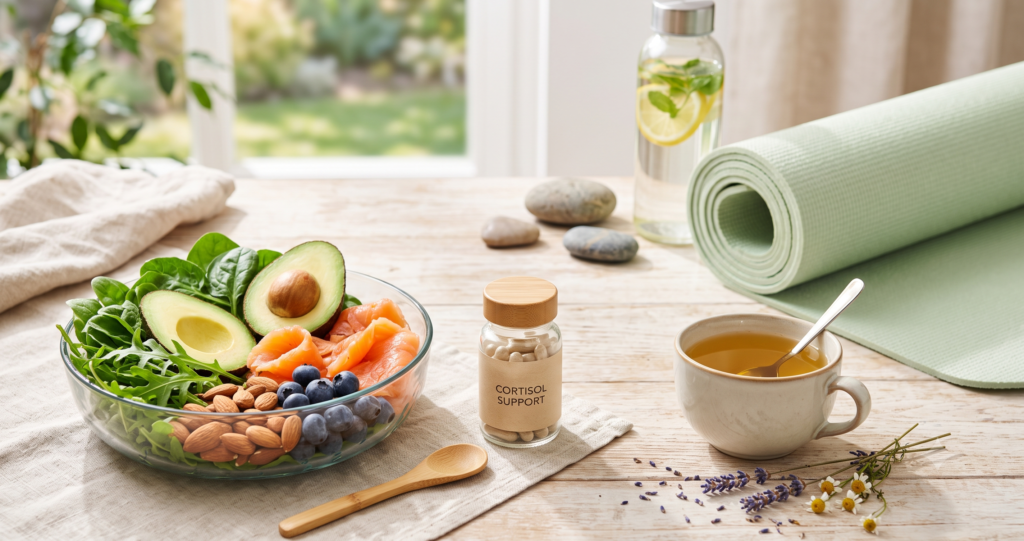
No cortisol supplement compensates for chronic stress, sleep loss, or a poor diet — the evidence reviews say this outright, and it’s worth taking seriously before spending money.
The non-negotiables:
- Protect deep sleep — the single highest-leverage cortisol intervention available to you, and it’s free
- Moderate exercise, not excessive — hard training without recovery raises cortisol rather than lowering it
- Consistent meal timing — erratic eating is itself a physiological stressor
- Limit late caffeine — it stacks directly onto your cortisol load and steals deep sleep
Supplements work alongside these. Not instead of them.
Frequently Asked Questions
Will lowering my cortisol automatically reduce belly fat?
Not necessarily. Evidence reviews specifically note that the supplements shown to lower cortisol are largely different from those showing promise for visceral fat reduction — the two don’t map onto each other as cleanly as marketing suggests.
Is ashwagandha or Korean Red Ginseng better for stress?
Ashwagandha currently has more consistent cortisol-lowering evidence. Korean Red Ginseng’s research suggests it may blunt cortisol increases under stress specifically. They’re not directly interchangeable, and ashwagandha carries more contraindications.
Can I take a cortisol supplement if I’m on thyroid medication?
This requires a doctor conversation. Ashwagandha in particular is generally not recommended alongside thyroid medication or for those with thyroid disorders.
How long before adaptogens show any effect?
Clinical trials in this space typically run 6 to 12 weeks. Anything promising results in days isn’t reflecting how this research is actually conducted.
Conclusion
Cortisol and belly fat are genuinely linked — but “supplement lowers cortisol, therefore belly fat disappears” is a marketing story, not a research finding. Ashwagandha has the strongest cortisol data with real contraindications; Korean Red Ginseng has more modest but real evidence for blunting stress-driven cortisol spikes. Neither replaces sleep, sane exercise, and consistent eating.
If you’re weighing a ginseng-containing formula against a completely different approach to stubborn fat, the comparison is worth making carefully.