The Role of Fiber in Appetite Control

Disclosure: This site may contain affiliate links. This content is for informational purposes only and does not constitute medical advice.
Everyone’s chasing Ozempic. Almost nobody knows their own gut can be prompted to make the same hormone the drug mimics — for the price of a bowl of oats.
That’s not wellness-influencer hype. It’s the conclusion of a 2026 scientific review, and it reframes what fiber actually does.
The Hormone Behind the Hype
The blockbuster weight-loss drugs — Ozempic, Wegovy — work by mimicking GLP-1, a hormone your gut naturally releases after you eat. GLP-1 slows stomach emptying, signals fullness to your brain, and helps regulate blood sugar.
Here’s what the drug ads don’t mention: your body already makes GLP-1. The question is whether you can prompt it to make more, naturally. And fiber turns out to be one of the most direct levers.
What the 2026 Research Actually Found
A scoping review published in Frontiers in Endocrinology pulled together 52 studies (over 1,000 participants) examining whether dietary fiber boosts the body’s own GLP-1 and satiety.
The conclusion: dietary fibers can stimulate endogenous GLP-1 secretion through microbial fermentation and gut hormone signaling, potentially enhancing satiety and supporting weight management.
In plain terms — feed the right fiber to your gut bacteria, and the fermentation process prompts your gut to release more of the same fullness hormone that pharmaceutical companies spent billions replicating.
But — and the researchers are careful here — not all fiber does this equally.
Why Not All Fiber Is Equal
This is where most “eat more fiber” advice falls short. The 2026 review found different fibers do different jobs:
- Beta-glucans (from oats and barley) showed the most consistent effects on subjective satiety — 6 of 9 studies positive. These form viscous gels that slow gastric emptying, prolonging fullness.
- Dextrins stood out for affecting both GLP-1 and satiety together.
- Other fibers hit one target or the other, but rarely both.
The mechanism split matters: some fiber makes you feel full by physically slowing digestion (viscosity), while other fiber works by feeding bacteria that produce appetite-signaling compounds (fermentation). The best food sources deliver both.
The Connection Between Gut Bacteria and Cravings
The Fermentation Connection
Here’s the deeper mechanism, and it ties directly to gut health. When fermentable fiber reaches your large intestine, bacteria break it down into short-chain fatty acids — and those compounds stimulate the release of both GLP-1 and PYY, another satiety hormone.
One controlled study found that 10g of a soluble fiber taken with a meal measurably stimulated GLP-1 and PYY production, reduced hunger, and lowered how much people expected to eat afterward.
So fiber isn’t just “filling.” It’s biochemically active — recruiting your gut bacteria to send fullness signals to your brain.
The Foods That Actually Deliver
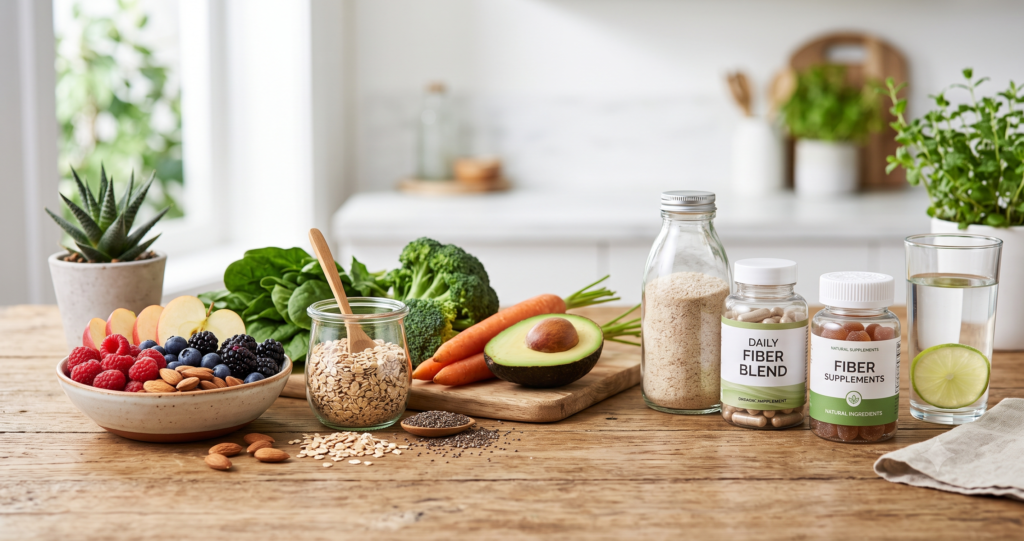
You don’t need a supplement to start. The most research-backed sources:
- Oats and barley — the richest beta-glucan sources, the fiber with the strongest satiety evidence
- Legumes — beans, lentils, chickpeas: fermentable fiber plus protein
- Onions, garlic, leeks, asparagus — rich in inulin, a fermentable prebiotic fiber
- Slightly-green bananas — resistant starch, a potent fermentation substrate
- Jerusalem artichoke — one of the densest inulin sources available
A “food-first” approach is exactly what the 2026 review reinforced.
The Honest Limitations
Two caveats, because this is fast-moving science:
First, many of these studies were small and short-term — the review flagged sample sizes as a real constraint. This is promising, not settled.
Second, endogenous GLP-1 from fiber is far more modest than what a GLP-1 drug delivers. Fiber won’t replicate Ozempic-level effects. What it can do is nudge your own satiety signaling upward, naturally, as part of a broader eating pattern — a supporting tool, not a pharmaceutical replacement.
Frequently Asked Questions
Can fiber really increase GLP-1 like Ozempic?
Fiber can stimulate your body’s own GLP-1 through gut fermentation, per a 2026 review, but the effect is far more modest than GLP-1 medications. It’s a natural supporting tool, not a drug replacement.
Which fiber is best for appetite control?
Beta-glucans from oats and barley showed the most consistent satiety effects in the 2026 review, largely because they form viscous gels that slow digestion and prolong fullness.
How much fiber do I need to see an effect?
Studies showing hormonal effects often used doses around 10g of a specific fiber with a meal. General guidance suggests most adults fall short of recommended daily fiber, so increasing intake gradually from whole foods is a reasonable start.
Will fiber supplements work as well as food?
Some isolated fibers show effects in studies, but the research reinforces a food-first approach, since whole-food sources deliver multiple fiber types plus other nutrients. Increase fiber gradually to minimize digestive discomfort.
Conclusion
Fiber’s role in appetite control is bigger than “it fills you up.” The 2026 research shows fermentable fibers can prompt your gut to release more of its own GLP-1 and PYY — the same satiety hormones behind today’s most talked-about weight-loss drugs — through a real, measurable mechanism.
It won’t match a pharmaceutical, and the research is still maturing. But oats, legumes, and inulin-rich vegetables offer a genuine, food-first lever on appetite that most people are underusing.
Now, if hormones are on your mind — one of the most common questions women over 40 ask is whether their birth control is quietly working against them. The evidence is more surprising than you’d expect.
How Hormonal Birth Control Affects Weight After 40