HepatoBurn Ingredients Explained: Silymarin, Berberine, Molybdenum and More

Disclosure: This post contains affiliate links. If you click through and make a purchase, we may earn a commission at no additional cost to you. This content is for informational purposes only and does not constitute medical advice.
KEY TAKEAWAYS
- HepatoBurn combines liver-support ingredients — silymarin and berberine lead, with betaine, molybdenum, and glutathione supporting.
- Silymarin and berberine have real human evidence; the supporting ingredients are more plausible than proven.
- Every strong result in the research came paired with diet and weight loss.
- Honest verdict: a well-reasoned ingredient stack, best used as support alongside the fundamentals.
Product Summary — HepatoBurn
Approach: Liver-support / fat metabolism — silymarin, berberine, betaine, molybdenum, glutathione, Mediterranean nutrients
Format: Capsule, non-stimulant
Best for: Adults 40+ targeting stubborn belly fat via liver function
Visit the official HepatoBurn website
A supplement is only as good as what’s inside it — so instead of trusting the label’s promises, let’s take HepatoBurn’s ingredients one by one and rate each against actual research. The strong, the plausible, and the honest gaps.
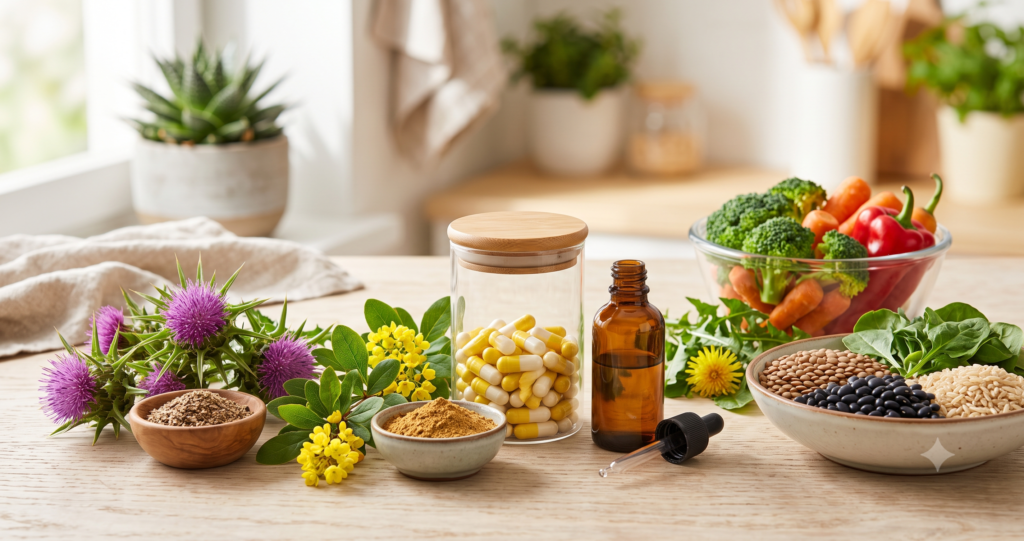
Silymarin (Milk Thistle) — The Anchor
Evidence: Strong (for liver function)
Silymarin is HepatoBurn’s liver-protective centerpiece, and it’s the best-studied liver ingredient available. A 2024 systematic review found it reduces liver enzymes ALT and AST in NAFLD trials at 140–420 mg daily, with a 48-week trial showing fibrosis improvement on biopsy.
Its benefit for fat is indirect — via a healthier liver — and best paired with weight loss. But as a liver-support anchor, it’s genuinely evidence-backed.
Milk Thistle and Silymarin: Do They Actually Support Fat Loss?
Berberine — The Metabolic Engine
Evidence: Strong (for liver fat and metabolism)
Berberine is the standout for fat metabolism. A PLOS One randomized controlled trial found berberine plus lifestyle reduced liver fat content by 52.7% versus 36.4% for lifestyle alone, with better weight and insulin-resistance outcomes. A review of 65 studies confirmed it modulates lipid and glucose metabolism and facilitates fatty acid β-oxidation.
The honest nuance: a meta-analysis found berberine significantly reduced body weight and waist circumference but did not significantly change liver enzymes — so its benefit may run more through metabolism than directly on the liver. Either way, it’s one of the better-evidenced natural metabolic ingredients.
Betaine — The Plausible Supporter
Evidence: Moderate / mechanistic
Betaine (trimethylglycine) plays a real role in how the liver processes fat — it’s involved in methylation reactions that help move fat out of the liver. There’s mechanistic support and some research, though robust human weight-loss data is limited. A sensible supporting ingredient, not a proven headliner.
Molybdenum — The Trace Cofactor
Evidence: Essential nutrient, not a fat-loss agent
Molybdenum is a trace mineral that acts as a cofactor for several liver enzymes, including those involved in processing sulfur compounds and toxins. It’s genuinely essential to liver enzyme function — but that’s different from being a demonstrated fat-loss ingredient. Its role here is supporting the liver’s enzymatic machinery, not burning fat directly. Honest framing: necessary nutrient, not a weight-loss driver on its own.
Glutathione — The Master Antioxidant
Evidence: Central to liver function; absorption debated
Glutathione is the body’s master antioxidant and is genuinely central to liver detoxification and protecting liver cells from oxidative stress. The honest caveat: the absorption of oral glutathione supplements is debated, with some research questioning how much survives digestion. So the ingredient is legitimate and important in the body — its delivery via capsule is the open question.
–> See the latest HepatoBurn pricing and availability
The Pattern Across All Ingredients
Step back and a clear pattern emerges. HepatoBurn’s stack is well-reasoned — every ingredient has a legitimate liver connection, and the two leads (silymarin, berberine) have real human evidence. That already sets it apart from formulas built on invented mechanisms.
But the honest through-line is the same one that runs through all this research: the strong results came paired with diet and weight loss, and the supporting ingredients (betaine, molybdenum, glutathione) are more plausible than proven as standalone fat-loss agents.
The formula’s logic is sound. The expectation has to be realistic.
Pros and Cons
Pros: Two lead ingredients (silymarin, berberine) with real human evidence. Every ingredient has a legitimate liver-function rationale. Non-stimulant — gentler for 40+ and caffeine-sensitive users. Well-reasoned, coherent stack rather than random “detox” filler.
Cons: Supporting ingredients (betaine, molybdenum, glutathione) are more plausible than proven for fat loss. Oral glutathione absorption is debated. No independent trial on the finished product. Strong ingredient results required “plus lifestyle.”
Frequently Asked Questions
What are HepatoBurn’s main ingredients?
Silymarin (milk thistle) and berberine are the evidence-backed leads, supported by betaine, molybdenum, glutathione, and Mediterranean nutrients. The leads have real human research; the supporting ingredients have legitimate liver roles but weaker standalone fat-loss evidence.
Which HepatoBurn ingredient has the best evidence?
Silymarin has the strongest evidence for liver function, and berberine has striking data for reducing liver fat (52.7% in one trial, plus lifestyle). These two carry most of the formula’s evidentiary weight.
Does molybdenum help with weight loss?
Not directly. Molybdenum is an essential trace mineral that acts as a cofactor for liver enzymes — important for liver function, but not a demonstrated fat-loss agent. Its role is supporting the liver’s enzymatic machinery.
Is the glutathione in HepatoBurn effective?
Glutathione is genuinely central to liver antioxidant function, but the absorption of oral glutathione supplements is debated. So while the ingredient is legitimate and important, how much benefit an oral capsule delivers is an open question.
Final Verdict
Bottom line: HepatoBurn’s ingredient list is well-reasoned and, in its two leads, genuinely evidence-backed. Silymarin reliably supports liver function, and berberine has striking data on liver fat — a stronger evidentiary foundation than most fat burners can claim. The supporting cast (betaine, molybdenum, glutathione) all have legitimate liver roles, even if they’re more plausible than proven as fat-loss agents on their own.
The honest verdict: this is a coherent, liver-focused stack — not “detox” filler — best used as genuine support alongside diet and weight loss, over 8–24 weeks, ideally cleared by a doctor if you’re on medication. Judged by its ingredients against real research, it’s a defensible choice for the 40+ audience willing to do the fundamental work.
Visit the official HepatoBurn website here
References
- PLOS One — Efficacy of berberine in patients with NAFLD (52.7% liver fat reduction). https://journals.plos.org/plosone/article?id=10.1371/journal.pone.0134172
- Remedy’s Nutrition / 2024 systematic review — Milk thistle for fatty liver: evidence. https://remedysnutrition.com/blogs/letter-vitamins/milk-thistle-for-fatty-liver-and-nafld-evidence
- Journal of Food Biochemistry (2023) — Berberine on NAFLD: systematic review of 65 studies. https://onlinelibrary.wiley.com/doi/10.1155/2023/7277060
- ScienceDirect — Berberine on obesity parameters and liver enzymes: meta-analysis. https://www.sciencedirect.com/science/article/abs/pii/S2405457720300802
About the author: Diana Woods researches and writes evidence-based content on weight management and metabolic health for WeightLossReviewPro. Her articles are grounded in current published research and cite primary medical sources. Diana is a content researcher and writer, not a medical professional — her work is informational and is not a substitute for advice from your own doctor.