
The 6 P.M. Window Where Everything Falls Apart

Key Takeaways
- The popular explanation, that willpower is used up by evening, did not hold in the largest test of it. That doesn’t make the hard evening unreal. It means the usual reason is probably wrong.
- A more likely explanation is logistical: a tired person, a short window, and no decision made yet about what happens first.
- The best-supported tool here is an if-then plan about the hour itself: “when I walk in, I do this first.” It’s about sequence, not about food.
- The evidence for that tool is decent but weaker for hard, long-term goals, and the original estimates are probably somewhat inflated.
You walk in at 6:05. The bag goes down somewhere it shouldn’t. Someone asks what’s for dinner, and you realize you’ve been asked that question in your head since about two o’clock without answering it.
Whatever happens next, it happens fast. The pan goes on, or the phone comes out, or the cupboard opens and stays open. Within fifteen minutes the evening has been decided, and you can’t point to the moment you decided it.
This is the hour most blogs call the danger zone, and most explain it the same way: you’ve used up your self-control by evening. That explanation is worth checking, because if it’s wrong, the usual fixes are aimed at the wrong thing.
The willpower story, and what happened to it
The idea has a name, ego depletion: exercising self-control on one task makes you worse at the next. It spread widely because it fits experience so well. Everyone has felt the end of a long day.
In 2021, Vohs and colleagues published a preregistered test in Psychological Science that gave the idea its best chance. It ran in 36 laboratories across multiple countries, with 3,531 participants, using two different protocols. After exclusions set in advance, the difference between the depleted and non-depleted groups was d = 0.06 and not statistically significant. The data were about four times more likely under “no effect” than under an effect. The authors concluded depletion “is not as reliable or robust as previously assumed.”
An earlier multi-lab replication, led by Martin Hagger in 2016, also reported weak results; I couldn’t open its abstract, so I’m only noting that it exists.
A few honest limits. The participants averaged about 21 years old, and the tasks were letter-crossing and constrained story-writing, not cooking dinner after work. A failed lab replication says the specific effect is shaky. It doesn’t say your evening is imaginary. Something real still happens at 6 p.m. The question is what.
What I think is going on (and where I’m guessing)
I can’t point to a study that identifies 6 p.m. as a special window. That part is this blog’s hypothesis, built from the failure of the usual explanation and from how evenings are actually laid out.
Consider what the hour contains. You’ve just changed context: from work, or the car, or a school pickup, into a house with its own demands. You’re probably tired, though the tiredness may be about the day and not about self-control. People are asking you things. And the dinner question is still unanswered, which means the first decision of the evening is made under pressure with the least information.
Put that way, the problem isn’t strength. It’s that the hour is crowded and nothing in it has been settled. A crowded hour with no order gets ordered by whatever is nearest.
The tool with actual evidence
The most-tested way to settle something before the moment arrives is the if-then plan, which researchers call an implementation intention: “If situation X happens, then I will do Y.”
The standard source is a 2006 meta-analysis by Peter Gollwitzer and Paschal Sheeran, covering 94 independent studies and more than 8,000 participants, per a secondary summary I could verify (I couldn’t open the paper itself). It found an effect of d = 0.65 for people with an if-then plan compared with people who only had the goal. That’s a medium-to-large effect by the usual yardsticks.
The caveats matter. The effects tend to be smaller for difficult, long-term goals than for one-off actions. Many of the included studies used students and short follow-ups. And the meta-analysis predates modern methods for catching publication bias, so later work suggests the real average may be somewhat smaller. An if-then plan also does nothing for a goal you don’t hold.
So it’s a decent tool with a ceiling, used for something that’s concrete and recurring. An evening is exactly that.
Plan the hour, not the dinner
Here is the part that’s easy to get wrong. This blog doesn’t tell you what to cook or eat, and an if-then plan about dinner would be a food plan in disguise. The plan I mean is about sequence.
A few examples of the shape, not rules:
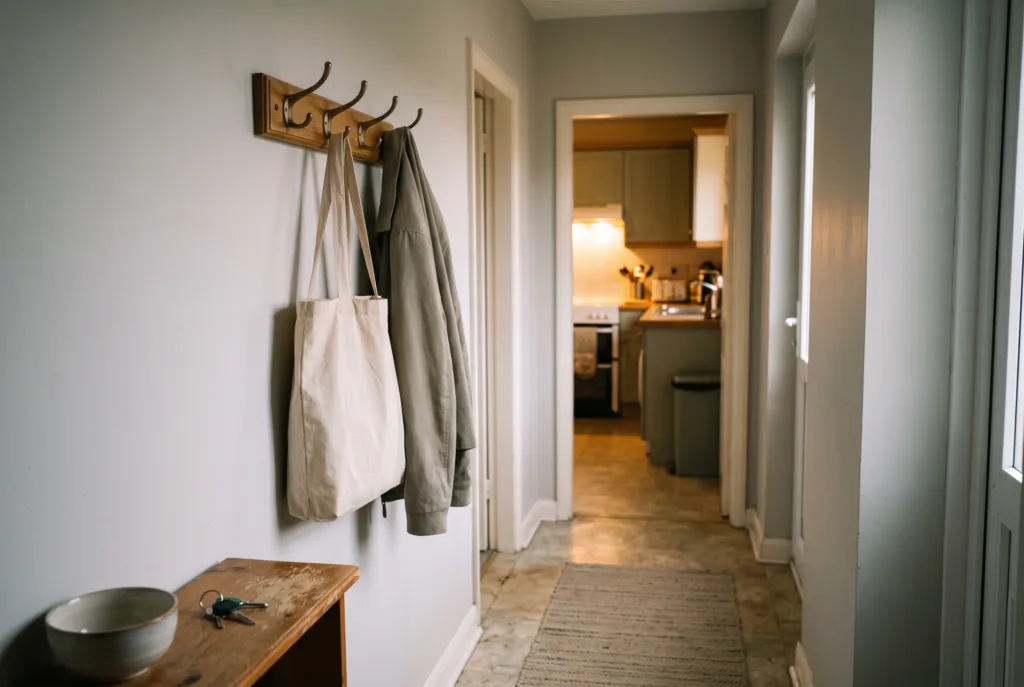
If I walk in the door, then the bag goes on the hook and I put the kettle on before I look at anything else.
If someone asks what’s for dinner, then I answer with what’s happening next, not what the meal is: “In ten minutes.”
If the phone comes out, then it goes face down on the counter, not in my hand, until the pan is on.
None of these mentions food. Each settles a small decision in advance so that it isn’t made in the crowd. That’s the whole mechanism.
The thing to decide in daylight
There’s one decision I’d move out of the evening, and it’s still not a menu: who is responsible for the first ten minutes.
In a household with more than one adult, the 6 p.m. window often belongs to nobody. Everyone assumes someone else has started. Naming who begins, and what “begin” means, removes a quiet source of friction that looks like a food problem and isn’t.
If you live alone, the equivalent is deciding what you do in the first five minutes in the house. The answer can be as plain as sitting down. A settled first five minutes beats an unsettled hour.
What if it falls apart anyway
It will, some evenings. The if-then research says plans help on average, not always. A late meeting, a sick kid or a bad day can break any sequence.
This blog’s view, and I’d hold it as a view and not a finding, is that a broken evening is information about the evening. It’s not a verdict on you. The sequence was too long, or the hour too crowded, or the plan too ambitious for a Tuesday. Adjust the plan, not the person.
The honest summary
The popular explanation for the evening collapse lost its best test. A better-supported tool exists for settling an hour in advance, with modest limits. Nobody has tested it on this exact hour, in this exact kitchen, and I’d rather say that than pretend.
What you can do is try one if-then plan for a week, about the first ten minutes, and see whether the evening has more room in it. If it does, keep it. If it doesn’t, you’ve learned the hour isn’t about sequence either.
References
- Vohs, K. D., et al. (2021). A multisite preregistered paradigmatic test of the ego-depletion effect. Psychological Science.
- Hagger, M. S., et al. (2016). A multilab preregistered replication of the ego-depletion effect. Perspectives on Psychological Science. (Not verified beyond the title and listing.)
- Gollwitzer, P. M., & Sheeran, P. (2006). Implementation intentions and goal achievement: A meta-analysis of effects and processes. Advances in Experimental Social Psychology, 38, 69–119. (Figures from a secondary summary.)

Diana Woods researches and writes about sleep, environment and everyday habit. She has no clinical training, and that shapes what this site does: instead of explaining what might be wrong with you, she reads the behavioural and environmental research and writes about the parts you can act on — the light in the hallway, the fifteen feet to the bathroom, what the morning does to the night that follows.
Every article here cites its sources, and she tries to include the parts researchers themselves flag as uncertain. Studies disagree, sample sizes are small, and correlation gets reported as cause more often than it should. Saying so is part of the job.