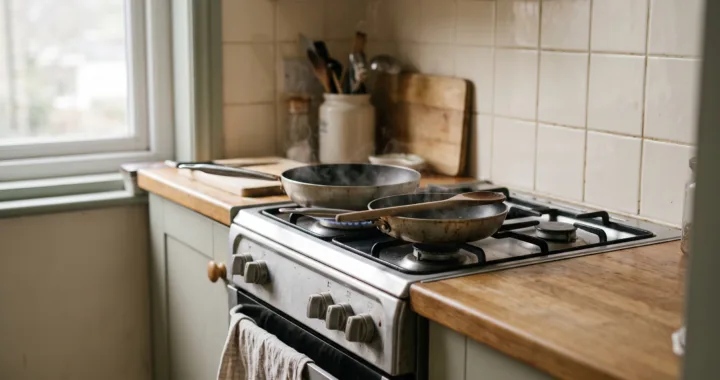
Grocery Shopping Habits: The Trip Decides the Week, Just Not the Way You’ve Been Told

KEY TAKEAWAYS
- The popular claim that most grocery purchases are impulse buys has little behind it. A study of 2,945 shoppers found about 20 percent of purchases were unplanned, and who was shopping mattered more than what the store did.
- The best-known “don’t shop hungry” study was retracted in 2018. Independent evidence is thinner: in one virtual-supermarket study, hunger changed what students bought, but only for those who struggled with a lab task on holding back a response.
- Paper lists beat digital lists at keeping people to their plan in one set of experiments, and phone use unrelated to shopping made people less likely to stick to their plans. Neither finding says anything about what belongs on a list.
- Nobody seems to have studied what happens when the household helps build the list. That part is common sense, not a finding, and it’s worth trying one change at a time.
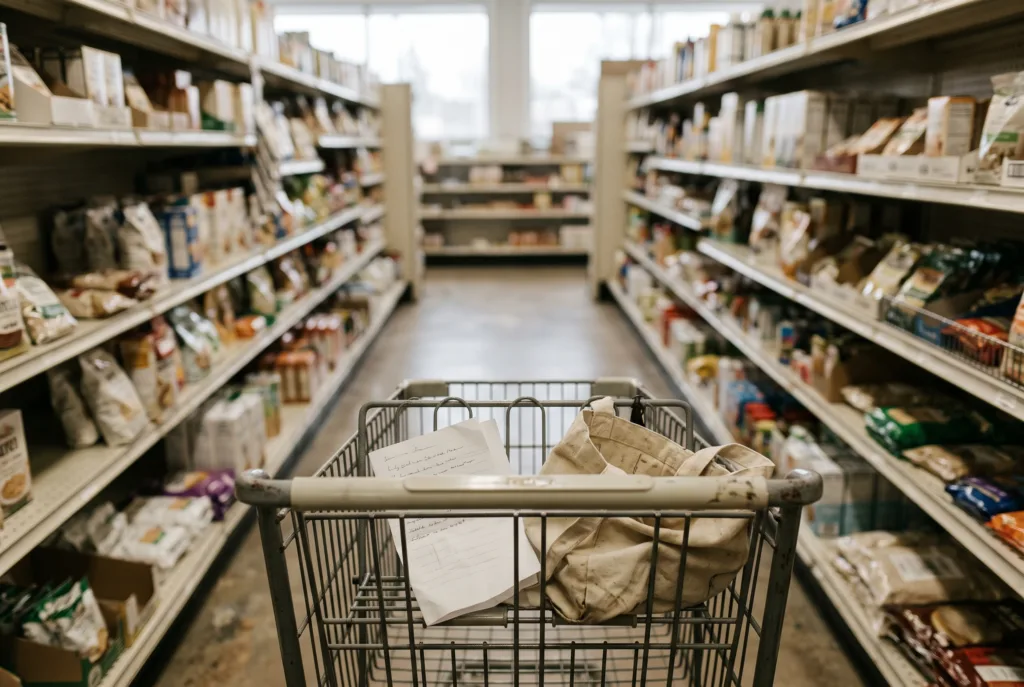
It’s 5:40 on a Tuesday. You’re in the cereal aisle with one hand on a cart that pulls left, a phone buzzing in the other, and no real picture of what the next four days look like. Somewhere behind you a child is negotiating. The list, if there is one, is a note you typed in the car and haven’t looked at since.
Most of us know the rules for this moment. Don’t shop hungry. Bring a list. Stay out of the aisles you don’t need. They get repeated with great confidence and almost never with a source, which turns out to matter, because at least one of them started in a study that was later retracted.
So this is a look at what’s underneath the rules: which ones have independent data, how much, and what any of it means when you’re shopping for a household that never signed up for your plans. The trip does matter. The reasons are just more interesting, and less tidy, than the slogans.
Why the trip matters at all
Whatever happens in the store ends up on a shelf at home, and what’s within reach at home seems to shape what gets picked up. That second part is the shakier link. When Cochrane reviewers pooled 24 trials on availability and distance, they rated the evidence low certainty, and most of it came from laboratories and short visits [1]. So the case for the trip rests on something plausible rather than proven: what comes through the door becomes the menu for the next few days, whether anyone chose it on purpose or not.
That’s enough to take the trip seriously. It isn’t enough to blame a single trip for a bad week.


Grocery shopping habits: most of the cart is decided before you arrive
You’ve probably heard that most grocery purchases are impulse buys, usually put somewhere around 60 or 70 percent. It’s one of those numbers that gets passed along without a footnote. When a team led by Wharton’s David Bell went looking, using questionnaires, receipts and home interviews with 2,945 shoppers across 21 stores, they found that closer to 20 percent of purchases were unplanned [2]. More than six in ten trips had no unplanned purchases at all, and when there were some, the average was about three.
The part I found most interesting is who. Shopper characteristics, things like age, income and household makeup, mattered more than anything the store itself did. Younger, single, higher-income households bought on impulse more often, and older shoppers and bigger families much less.
It’s a snapshot from two weeks in 2006, and “unplanned” means what shoppers told the researchers afterward, so I wouldn’t treat 20 percent as a law of nature. But if even roughly that is right, the trip is decided long before the doors slide open. It’s decided at the kitchen table, or in the car, or in a note on a phone, by whoever is shopping and whatever they knew about the week ahead.
The “don’t shop hungry” rule
The best-known version of the rule comes from a 2013 paper out of Brian Wansink’s lab at Cornell, published in a JAMA journal, reporting that hungry shoppers bought more [3]. JAMA Internal Medicine retracted it in 2018, along with two other papers from the same lab. That doesn’t make the advice wrong. It just means that particular paper can’t be the reason for it.
Independent evidence is thinner and more specific. A Dutch team ran a virtual supermarket with 94 undergraduates and measured two things: how hungry each student was, and how well each could hold back an automatic response in a simple lab task [4]. The students who found that task hardest bought more, and more of it was snack food, but only when they were hungry. The same kind of student, after eating, showed no such pattern. The “impulsive” label here was a score on a lab task, not a verdict on anyone. So hunger seemed to matter for some people and not others, in a simulated store, with students.
That’s about as far as I’d take it. Eating something before a trip costs almost nothing, and it’s a reasonable thing to try. It just isn’t a test of character, and it isn’t always your call. A lot of grocery trips happen at 5:40, on the way home from somewhere else.
A list is only as good as the phone it lives on
Then there’s the list. Yanliu Huang and Zhen Yang ran three experiments that tracked what people actually bought, comparing paper lists with digital ones [5]. Paper-list shoppers stuck closer to their lists, and digital-list shoppers made more unplanned purchases. Drexel’s write-up of the work put it at roughly nine in ten items bought from paper lists and roughly seven in ten from digital ones. The authors’ explanation is that writing by hand takes effort, and effort makes a list feel more binding.
A separate group looked at the phone itself. Sciandra, Inman and Stephen found that nearly half of the in-store phone use they saw had nothing to do with shopping, and that using the phone for other things made people less likely to follow their plans and more likely to buy on impulse, particularly people with high phone dependence [6].
Both findings come from marketing research, in tasks the researchers designed, and neither says anything about what belongs on a list. A list can be a bad list. Sticking to it only means you bought what you wrote down.
There’s a wrinkle for households. Paper lists seem to hold up better in these studies, but a list that three people can add to from three different places is almost always going to be digital. I found no study comparing a shared list with a solo one, so I can’t tell you whether the convenience cancels out the effect. If it does, the price may be a few unplanned items. If it means everyone’s request actually makes it onto the list, that may be a trade worth making, and that’s a judgment call, not a result.
Who the cart is for
Here’s the part nobody seems to have studied. A household cart isn’t one person’s. It’s a quiet decision about what lives in everyone’s kitchen, made mostly by whoever has the car and the free hour. That person is often the one with the least slack, fitting the trip between work and dinner and carrying everyone’s preferences around in their head. If Bell’s team is right that household makeup matters more than the store, then the shopper’s circumstances are the real variable, and the people at home are part of those circumstances.
I found no study of what happens when the household helps build the list, so take what follows as common sense and not as a finding. A list on the fridge that anyone can add to. A line or two that are theirs and not yours. A quick “what do you want this week” before you leave. No aisle has to be off limits for any of it to work. The point is only that the person who shops shouldn’t be the only one deciding, and nobody at home should find out what changed by opening a cupboard.
One change, not five
If you want to try something, change one thing about the next trip. Pick whichever is cheapest: write the list before you leave the house, or silence the phone once you’re inside, or eat something first, or ask the household what they’d like. Any of them will tell you more than another rule would. And if nothing changes, you’ve learned something about your own week that no study could.
References
- Hollands GJ, Carter P, Anwer S, King SE, Jebb SA, Ogilvie D, Shemilt I, Higgins JPT, Marteau TM. Altering the availability or proximity of food, alcohol, and tobacco products to change their selection and consumption. Cochrane Database Syst Rev. 2019;(9):CD012573. doi:10.1002/14651858.CD012573.pub3
- Bell DR, Corsten D, Knox G. From point of purchase to path to purchase: how preshopping factors drive unplanned buying. J Mark. 2011;75(1):31-45. Study details as reported in Knowledge at Wharton, “Not on the List? The Truth about Impulse Purchases.” knowledge.wharton.upenn.edu
- Wansink B, Payne CR, Chandon P? — see note below.
Wait, I need to fix reference 3 before you publish: I do not have the author list of the retracted paper from a source I read. Use the retraction notice instead:
- Hollands GJ, Carter P, Anwer S, King SE, Jebb SA, Ogilvie D, Shemilt I, Higgins JPT, Marteau TM. Altering the availability or proximity of food, alcohol, and tobacco products to change their selection and consumption. Cochrane Database Syst Rev. 2019;(9):CD012573. doi:10.1002/14651858.CD012573.pub3
- Bell DR, Corsten D, Knox G. From point of purchase to path to purchase: how preshopping factors drive unplanned buying. J Mark. 2011;75(1):31-45. Study details as reported in Knowledge at Wharton, “Not on the List? The Truth about Impulse Purchases.” knowledge.wharton.upenn.edu
- JAMA Intern Med. Notice of retractions: “First Foods Most: After 18-Hour Fast, People Drawn to Starches First and Vegetables Last,” “Fattening Fasting: Hungry Grocery Shoppers Buy More Calories, Not More Food,” and “Watch What You Eat: Action-Related Television Content Increases Food Intake” by Brian Wansink. 2018. jamanetwork.com
- Nederkoorn C, Guerrieri R, Havermans RC, Roefs A, Jansen A. The interactive effect of hunger and impulsivity on food intake and purchase in a virtual supermarket. Int J Obes. 2009;33:905-912.
- Huang Y, Yang Z. Write or type? How a paper versus a digital shopping list influences the way consumers plan and shop. J Assoc Consum Res. 2018;3(3):396-409.
- Sciandra MR, Inman JJ, Stephen AT. Smart phones, bad calls? The influence of consumer mobile phone use, distraction, and phone dependence on adherence to shopping plans. J Acad Mark Sci. 2019;47(4):574-594.

Diana Woods researches and writes about sleep, environment and everyday habit. She has no clinical training, and that shapes what this site does: instead of explaining what might be wrong with you, she reads the behavioural and environmental research and writes about the parts you can act on — the light in the hallway, the fifteen feet to the bathroom, what the morning does to the night that follows.
Every article here cites its sources, and she tries to include the parts researchers themselves flag as uncertain. Studies disagree, sample sizes are small, and correlation gets reported as cause more often than it should. Saying so is part of the job.